

Preview of the 23rd Human Rights Film Festival
As every year, the festival will be addressing a range of topics and stories, including among many others the role of women in religion, the climate emergency in Bangladesh as an example of what is happening in many other regions of the world, the feminisation of precarious working conditions in the textile industry, in this case in Eastern Europe.
It will also tell the story of the disappearance of Josef Mengele in South America after the Second World War, the difficulties faced by women who are victims of sexual violence when reporting the offence, and the sisterhood among refugee women.
The discussions to be held after the 7:00 / 8:00 p.m. screenings will explore in greater depth a number of current topics, involving representatives of the films, and individuals, activists and organisations working in the field of human rights, who will be sharing their experiences with the audience.
PREVIEW OF THE FEATURE FILMS OFFICIAL SELECTION
- Black Water (2025). Natxo Leuza. Spain
By the year 2050, Bangladesh will have approximately 220 million inhabitants, and a large part of its territory will be permanently submerged. This situation could lead to the forced displacement of between 10 and 30 million inhabitants of the country's southern coastline, forcing many Bangladeshis to flee as “climate refugees”, a human collective that is expected to reach 250 million people worldwide by mid-century. On a planetary scale, we are talking about the largest mass migration in human history. How long will Dhaka withstand the arrival of so many people?
- The Disappearance of Josef Mengele (2025). Kirill Serebrennikov. France-Germany
In the aftermath of the Second World War, Josef Mengele, “The Angel of Death” at Auschwitz, escapes to South America to rebuild his life in hiding. Through the eyes of his son who finds him again, Mengele is confronted with a past he can no longer ignore. From Buenos Aires to Paraguay via Brazil, Mengele will organize his methodical disappearance to avoid any form of trial.
- Girls & Gods (2025). Arash T. Riahi, Verena Soltiz. Austria-Switzerland
Can feminism and religion coexist? Girls & Gods is a fearless journey spearheaded by Inna Shevchenko —the project’s author and initiator— to explore this very question. Once renowned for leading FEMEN’s protests against patriarchal power structures, Shevchenko now trades protest for dialogue, engaging priests, imams, rabbis, theologians, and fellow activists in candid conversations. Together, they confront the divide between women’s rights and religious tradition, asking if age-old faiths can embrace gender equality and whether feminism can find a place within sacred halls.
- Iván & Hadoum (2025). Ian de la Rosa. España-Alemania-Bélgica
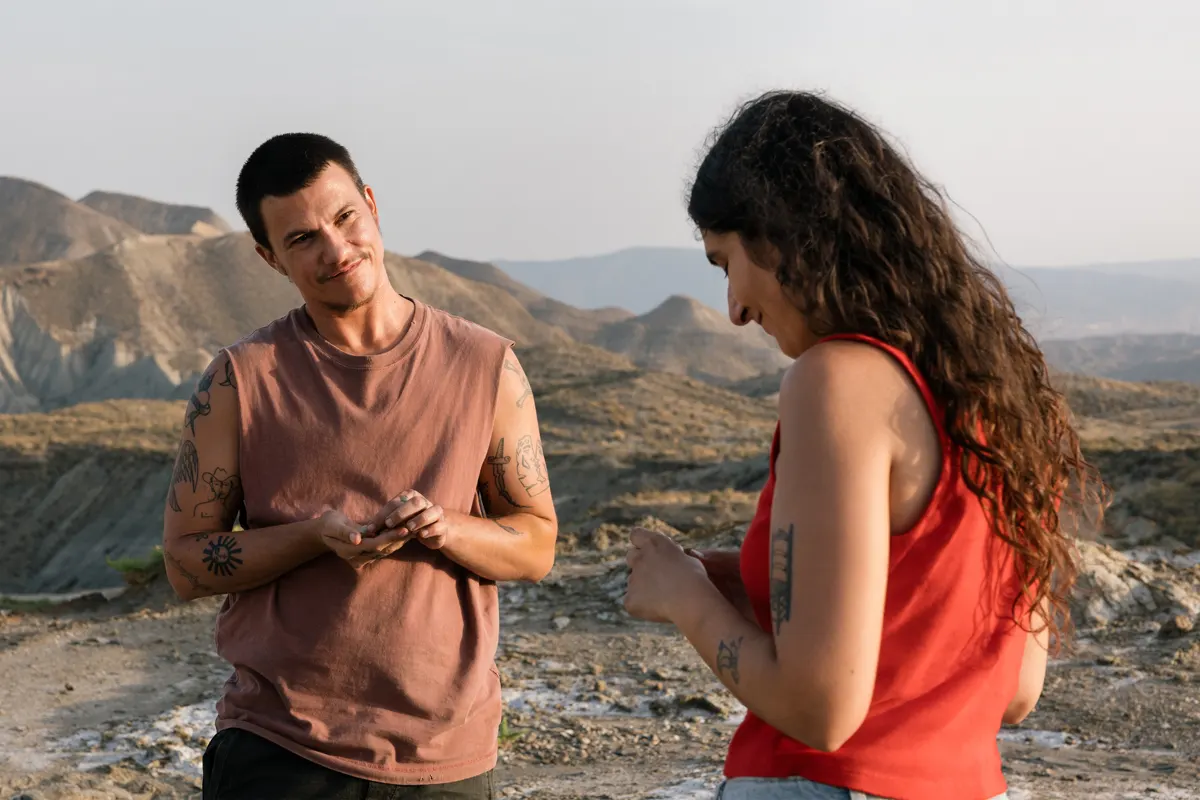
Iván falls in love with Hadoum, a new colleague at the greenhouse in Almeria where they both work. However, the promotion he has been longing for interferes with their relationship, forcing him to decide what type of person he wants to be. The début film from Ian de la Rosa, winner of the Teddy Award at the Berlinale and two Silver Biznagas (Special Jury Prize and Best Screenplay) at the Malaga Festival.
- Made in EU (2025). Stephan Komandarev. Bulgaria-Germany-Czech Republic
Iva works in a clothing factory in rural Bulgaria battling a persistent, yet mysterious illness. When it is revealed that she is the first case of COVID in her small town, the news spirals into an endless j’accuse: first from the factory owners eager to shift responsibility, then from her fellow co-workers, her son, and eventually her entire community, even though Iva hasn’t left her small town in years. With Iva’s public demonization escalating as the first victims of the virus emerge, she is quickly turned into a social outcast.
- Promised Sky (2025). Erige Sehiri. France-Tunisia-Qatar
Marie, an Ivorian pastor and former journalist, has lived in Tunisia for ten years. Her home becomes a refuge for Naney, a young mother seeking a better future, and Jolie, a strong-willed student carrying her family’s hopes. The arrival of a little orphan girl challenges their sense of solidarity in a tense social climate, revealing both their fragility and strength.
- Silent Rebellion (2025). Marie-Elsa Sgualdo. Switzerland-Belgium-France
15-year-old Emma-pregnant after a rape-defies her repressive rural Protestant community to carve a path of self-determination, transforming trauma into a catalyst for emancipation while confronting the moral hypocrisy of the village and the spectre of World War II around her. As the story progresses, an inescapable truth is revealed: no one is neutral in times of war.
- Sucia (2025). Bàrbara Mestanza, Marc Pujolar. Spain
After being sexually abused during a massage, actress Bàrbara Mestanza transforms her trauma into art — a raw, fearless theater play. Confronting the question “Why didn’t you do anything?” she embarks on a powerful journey to find her aggressor, challenge toxic masculinity, and reclaim justice on her own terms.


